
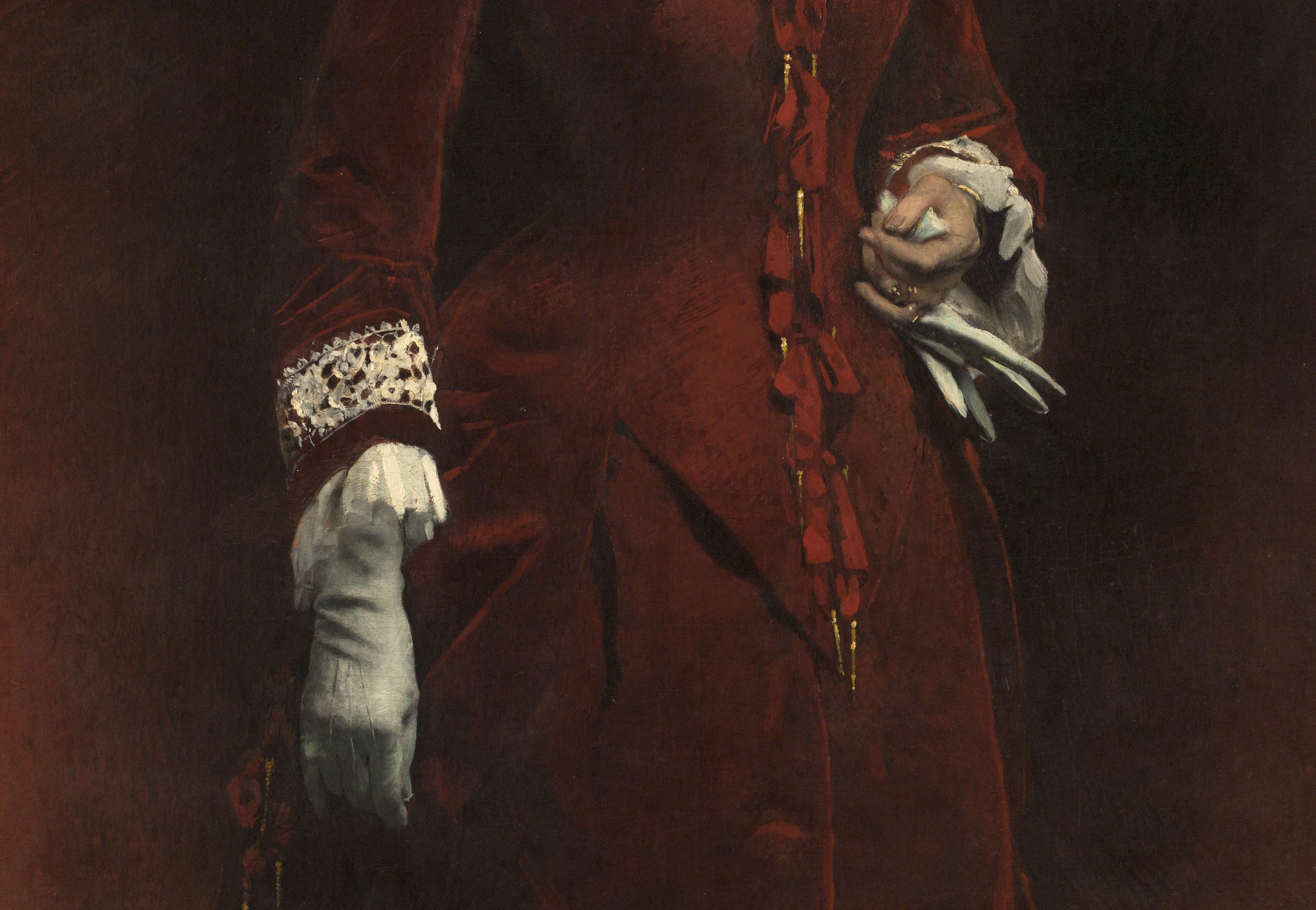
The following is a brief discussion of my poem Gloves, which I hope will be helpful to those of you who are studying this poem for your exams. Please keep in mind though that this will not replace the discussions you have in class about the poem, or the things your teachers may tell you to focus on – your teachers have a far better idea of what the examiners will be looking for. But this should provide you with some additional context for the poem, and may be able to suggest ways of looking at things that you hadn’t yet considered. If there are specific questions you have that are not covered here, let me know and I’ll see if they can usefully be added. However – and I can’t emphasise this enough – don’t ask me to do your homework for you!
Gloves
Great Grandmother’s gloves were kept for funerals,
in tissue paper, limp as something stillborn.
She drew them on slowly, the grey silk
of the other self she wore.
Through each service they lay folded
on her lap, water-stained wings of a moth.
Afterwards, she gives them to me
to put away, still warm, and marked
where her wedding band has worn to gold wire.
She slides the long pins out of her hair,
and I brush until it hangs, a fall
of frozen water down her spine.
She sends me to the garden for fresh flowers
and sits for a while, just visible through the open door,
straight-backed and still, with naked hands.
Some Background
Gloves is from my first collection, The Summer King, and is based on a combination of memory and imagination. (As most poems are!)
What prompted this particular poem?
I come from a family of long-lived women. My Great Grandmother died when I was 8 and she was 94. There’s a lovely family photo of four generations of us sitting on the lawn – Great Grandma sitting on a cane chair, me in her lap looking straight up into her eyes, Mum sitting on the grass at her knee, and Grandma standing on the other side of the chair, I think resting her hand on the back. So I knew my great grandmother, but I only ever knew her as an elderly woman. She’d been a widow for a long time – since her late forties or early fifties, I think – and lived with my mother’s parents on Cowarral, our family’s farm. She’d actually lived there as a young woman – it’s been in one branch or another of my mother’s family for over 150 years. Still is!
My memories of her are precious and we had a close bond, but I only saw her a couple of times a year. Because I was so young when she died, some of my memories are almost certainly an amalgam of actual memories and family stories. In my mind it was always either summer or autumn, although I know there were winters too, and I have no memory of her voice any more – just her presence. This poem tries to capture her as best I can, but some of the details are not things I actually remember – inventions, to convey a sense of who she was, how I felt about her, who she was in my life.
Such as?
Nope. Not going to tell you.
Really? Why not?
Because a poem is not an autobiography, or a news report. I’m using language not to relay a set of facts, but the evoke an emotional response that will help my readers see her through their own eyes, not just mine.
As I said in the discussion about The Pride of Lions – any poem is only 50% what the poet had in mind. If I’ve done my job properly, there will be a general poem that you take from the page, but from there it gets filled with your own experiences and thoughts and beliefs. What it means to me is going to be different – even if only very slightly – to what it means to you.
Ok, so what suggestions/hints do you have for a reader?
Start with the structure. What do you notice about the shape of the poem, and how it changes? Why do you think I might have done that? What would change if it was just two stanzas? Or a mixture of stanza lengths?
What patterns do you see in the poem? Why might they be there?
What are some of the images that you notice? What do they say about the subject, and about the speaker?
How do the images change as the poem unfolds?
Read the poem out loud. What are the sounds you hear most?
What does the poem suggest about the relationship between speaker and subject?
What does the poem say, if anything, about religion?
What, if anything, does the poem say about society?
What things are missing from this poem that you might expect to see? What does this suggest?
How does the title relate to the story of the poem?
What significance did gloves have for women of this period?
What do gloves like these feel like?
What other item (other than a pair of gloves) could have been used to describe this person, and what does the choice of gloves say about them? About the speaker?
How much time passes during the course of the poem?
When is the poem set? And where?
What stories, fairy tales, myths etc can you see in there?
What, if anything, does the poem say about power? How about agency?
What does the poem make you think of from your own experience?
How does the poem leave you feeling by the end? How does it do that?
Relatedly
This poem first appeared in a lovely UK poetry magazine called Smith’s Knoll (no longer in print, sadly), and the editor, Michael Laskey, chose it as the poem he wanted to write about. I’ve included his piece here, from Smith’s Knoll issue 37, for those who are interested. Remember that this is not the only way of looking at the poem, but it is one way. Enjoy!
Choosing which poem to write about in each issue is always pleasurable, but never easy. I had a shortlist of seven this time and finally settled on Gloves because I didn’t quite understand why I liked it so much. How come it had this effect on me? How did I know it was the real thing? I thought that having to write about it might help me find out.
Straightaway I notice that she’s not ‘Great Grandma’, but ‘Great Grandmother’, treated with the respect due to her great age. And already we’re at the heart of the poem – an old woman, near to death, observed by her great granddaughter. The description of the gloves conveys the young girl’s mixed feelings of fascination and revulsion – they’re wrapped ‘in tissue paper’, ‘limp as something stillborn’ and folded like the ‘wings of a moth’.
The first three verses focusing on these funeral gloves – her ‘other self’, her approaching death – are in the past tense, but the second part of the poem, the last three verses, are in the present. So why this change of tense? Does the memory of the gloves conjure her up, bring her vividly back to life maybe? Or is it that the second part, describing what happens when the Great Grandmother returns from one of her funerals, shows us the living woman and how she deals with mortality? Is this perhaps something that goes on being vitally present and exemplary for the narrator?
The gloves are ‘still warm’ – their warmth intensified by the subliminal rhyme with the contrasting ‘stillborn’ back in line 2 and spreading over to the wedding band ‘worn’ in the next line, the ‘gold wire’ that represents her fidelity and her direct family connection with the girl. Now the old woman relaxes, loosens her hair, though any relaxation is qualified by her stiffness – the ‘pins’ modulating to ‘spine’ and the ‘fall of frozen water’, a chilling but astonishingly beautiful feature of the girl’s mental landscape.
The ‘fresh flowers’ she is sent out to pick are the old woman’s response to death and the warmth returns through the open door. She’s ‘just visible’, just alive. In the simple but emotionally complex last line, we see her through the eyes of her great granddaughter – admirably ‘straight-backed’, while the repetition of ‘still’, recalling lines 2 and 8, emphasises the awful vulnerability of her ‘naked hands’.
– Michael Laskey
Smith’s Knoll #37
 A Dark Feathered Art